
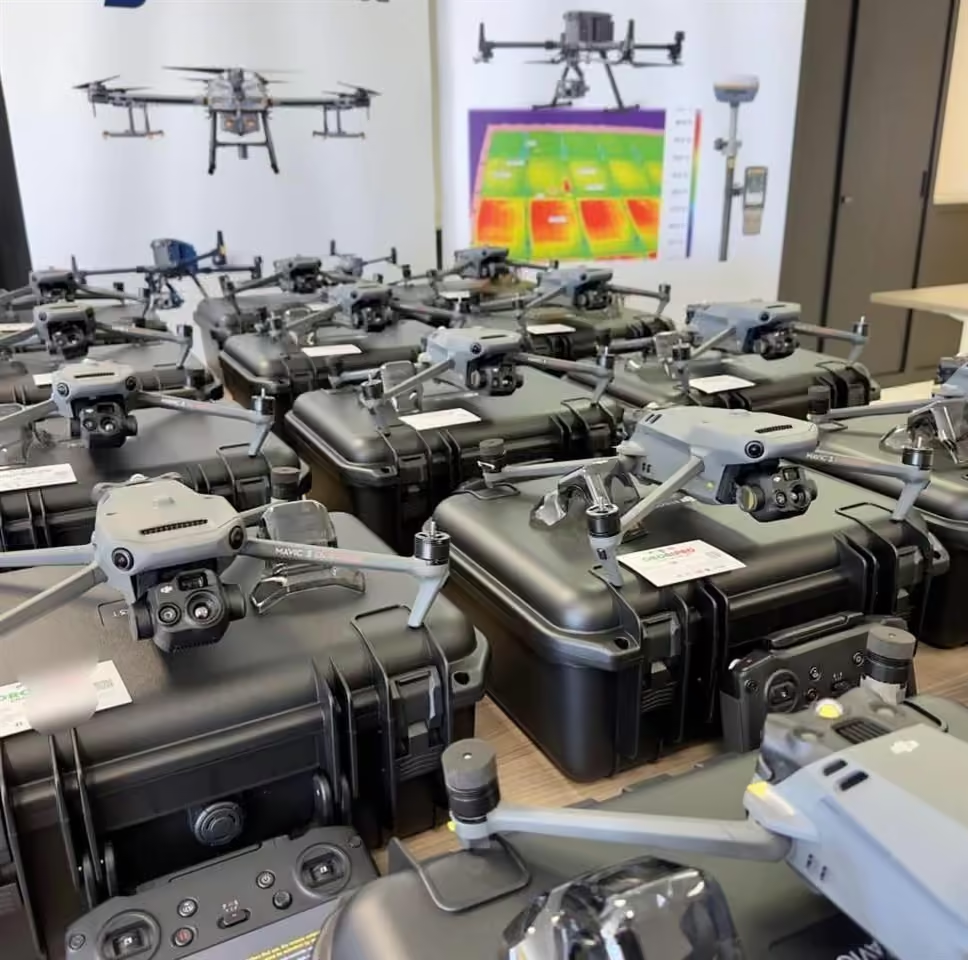
Associated Builders and Contractors has placed a hard number on something many construction technology teams already understood from experience: the construction industry’s drone capability is overwhelmingly built around DJI.
In ABC’s first Drone Usage Survey Report, 36.1% of responding contractors said their companies fly drones. Among the companies that do, 97.1% identified DJI as their primary manufacturer. The remaining 2.9% identified Autel Robotics.
Associated Builders and Contractors has placed a hard number on something many construction technology teams already understood from experience: DJI drones in construction are not merely common. For many contractors, DJI aircraft have become the foundation of aerial documentation, inspection and mapping workflows. That concentration is now colliding with FCC drone restrictions, import tarriff uncertainty and a larger construction drone compliance problem.
In ABC’s first Drone Usage Survey Report, 36.1% of responding contractors said their companies fly drones. Among the companies that do, 97.1% identified DJI as their primary manufacturer. The remaining 2.9% identified Autel Robotics. No American manufacturer registered as the primary platform among the choices reported in the survey.
That does not mean every American contractor uses DJI drones in construction, or that the survey describes every part of the construction market. ABC surveyed its members from May 1 through May 15, 2026, and nearly 75% of the responding contractors work in commercial construction. The results are best read as a snapshot of ABC’s contractor membership, not a universal census of the industry. Even with that limitation, the concentration among drone-using respondents is extraordinary.
That dependence now sits directly in the path of federal equipment restrictions, changing procurement requirements and unstable import costs.
This is not merely a debate about which drone brand has the better camera. It is a business continuity issue involving aircraft, batteries, payloads, software, pilot training, project requirements and the repeatability of field data.
The short version for construction leaders
- Existing, lawfully acquired DJI aircraft have not suddenly become illegal to fly.
- The FAA rules governing the flight and the FCC rules governing radio equipment are different regulatory systems.
- The December 2025 FCC action primarily constrains the future authorization of new foreign-produced models and components.
- A July 2026 FCC proposal could go further by restricting continued importation and marketing of certain previously authorized equipment, including categories relevant to thermal, LiDAR and docked operations. It is a proposal, not a final rule (even drones equipped with LiDAR collision avoidance are affected).
- Previously authorized covered drones may continue receiving qualifying software and firmware updates through at least January 1, 2029 under an FCC waiver.
- Customer procurement rules can disqualify an aircraft even when the FAA permits the flight.
- Tariffs and customs charges affect landed cost, but they are not the same thing as an FCC prohibition.
- The practical response is to inventory the current fleet, document the workflows it supports and validate a contingency before a failure or contract requirement forces the decision.
Construction companies do not need another headline declaring that DJI is “banned.” They need an accurate account of what changed, what did not change and where their operating exposure actually sits.
What the ABC survey actually found
ABC surveyed its contractor members in May 2026. The report covered company participation, equipment investment, operational applications, payloads, manufacturers and obstacles to adoption.
The top-line adoption figure was 36.1%. That places drones well beyond the experimental stage in construction, while also leaving substantial room for additional adoption.
Among the contractors already flying, the leading applications were:
- Site-progress monitoring: 80.8%
- Marketing and media: 77.5%
- Inspections: 50.0%
- Aerial mapping or photogrammetry: 37.5%
- Volumetric analysis: 22.5%
- Land-surveying applications, as characterized by respondents: 20.8%
The distinction between inspections and mapping matters. ABC’s announcement grouped “inspections and mapping” around the 50% figure, but the underlying report lists inspections at 50% and aerial mapping or photogrammetry at 37.5% as separate applications.
The hardware profile is equally revealing:
- High-resolution RGB cameras: 81.3%
- RTK or PPK positioning: 21.9%
- Thermal cameras: 19.8%
- LiDAR sensors: 18.8%
- Lighting systems: 4.2%
- Payload-delivery systems: 2.1%
- Multispectral or hyperspectral sensors: 2.1%
- Loudspeakers: 1.0%
These figures show a market centered on practical documentation, inspection and measurement support. Construction teams are not primarily buying exotic aircraft. They are buying portable tools that help them record conditions, communicate progress, observe inaccessible areas and collect structured aerial data.
Those applications extend beyond individual flights. Apollo has previously examined how drones in construction can help reduce costly mistakes through repeatable documentation and improved project visibility.
The spending data reinforces that conclusion. Approximately 61.9% of drone-using respondents reported total investment between $1,000 and $10,000. Another 11% reported spending between $10,000 and $50,000. Only a relatively small portion had invested at enterprise-fleet levels.
DJI’s construction advantage was not one individual specification. It was the amount of useful field capability available inside those modest budgets.
Why DJI drones in construction have become a business continuity risk
The 36.1% adoption number says drones have become mainstream enough to matter. The 97.1% manufacturer number says the capability is concentrated enough to be vulnerable.
The ABC findings show that DJI drones in construction are not occupying a narrow specialty. They support some of the industry’s most frequently used aerial workflows.
A construction company may describe its drone as a camera, but its actual dependency usually extends much further:
- Aircraft and controllers
- Flight batteries and charging equipment
- Propellers, cables and replacement parts
- RGB, thermal or other integrated payloads
- RTK base stations or network correction workflows
- Mission-planning applications
- Automated flight templates
- Processing software
- Historical project data
- Pilot familiarity and internal training
- Written procedures and insurance schedules
Once progress documentation becomes recurring, the workflow also develops a history. Teams learn which altitude, angle, route, overlap and naming convention produces the information that project managers expect. A replacement that technically flies may still fail to reproduce the output reliably.
This is why “buy an American drone” is an incomplete transition plan. A contractor must replace the entire operational result, not merely the airframe.
Why construction drone fleets concentrated around DJI
The survey identifies the concentration. It does not establish a single cause. Operationally, however, the pattern is understandable.
DJI combined compact aircraft, integrated cameras, stable flight controls, automated missions and a broad accessory and software ecosystem at price points small construction teams could approve. A contractor could start with progress photographs and later add RTK positioning, mechanical-shutter mapping, thermal imaging or repeatable automated capture without creating a full aviation department.
That matters because construction technology is adopted at the project level. The winning tool is often the one a superintendent or project engineer can deploy quickly, transport between sites and fit into an existing reporting process. Domestic origin alone does not replace those characteristics.
This is also why the transition cannot be evaluated as a patriotic vs. foreign purchasing argument. Federal policy may have legitimate national security and industrial based objectives. Contractors still have to deliver work in the field. A viable replacement must satisfy both policy and production requirements.
Four rules affecting DJI construction drones
Much of the confusion around DJI comes from combining several unrelated legal and commercial questions. Contractors should separate them.
1. FAA operating authority
The Federal Aviation Administration regulates flight operations in the National Airspace System. For most commercial small-drone work, that means operating under Part 107.
The FAA requires the remote pilot in command to hold a Remote Pilot Certificate, and each aircraft operated under Part 107 must be registered. Controlled-airspace operations require authorization. Night operations, operations over people or moving vehicles, visual line of sight limitations and Remote ID can introduce additional requirements depending on how the mission is conducted.
The manufacturer of the aircraft does not, by itself, determine whether a routine Part 107 flight is lawful.
2. FCC equipment authorization
The Federal Communications Commission regulates the radio-frequency equipment inside drones, controllers and related components.
On December 22, 2025, the FCC added foreign-produced UAS and UAS critical components to its Covered List. Covered equipment cannot receive new FCC equipment authorization, which most wireless devices require before they can be imported, marketed or sold in the United States.
The action primarily affected new device models. It did not prohibit continued use of previously purchased drones or immediately stop the sale and importation of models that had already received FCC authorization.
That is the central correction to claims of an immediate DJI drone ban. Previously authorized aircraft did not suddenly become illegal to fly because of the December 2025 FCC action. The larger concern is whether future aircraft, batteries, controllers and critical components will remain available.
The Covered List reaches beyond complete aircraft. It can include communications systems, flight controllers, ground-control stations, navigation systems, batteries, smart batteries and motors. Long-term supportability therefore matters as much as aircraft availability.
The FCC has also established exemptions and conditional-approval processes for certain equipment. Procurement teams should check the current Covered List instead of relying on a manufacturer’s nationality or an older article.
In May 2026, the FCC also extended a waiver allowing previously authorized covered UAS to continue receiving qualifying software and firmware updates through at least January 1, 2029.
That reduces one immediate risk for existing fleets. It does not guarantee indefinite parts availability, manufacturer support or customer acceptance.
3. Government and customer procurement restrictions
A drone can remain legal to fly under FAA rules while still being unacceptable for a particular contract.
Federal agencies, state and local governments, utilities, critical-infrastructure owners and prime contractors may impose their own approved-equipment, data-security or country-of-origin requirements. Those requirements can be narrower than the general rules governing commercial operation.
Some buyers refer to the Blue UAS framework. Others create contract specific lists or flow federal requirements down to subcontractors. Still others focus on where imagery is stored, whether an aircraft requires cloud connectivity and how project information moves through the vendor’s systems.
The correct question is not only, “Can this aircraft legally fly?” It is also, “Will this customer accept the aircraft and data workflow for this project?”
4. Tariffs, duties and import costs
Tariffs are a separate issue from FCC authorization.
United States trade actions involving China have changed repeatedly, including Section 301 measures, reciprocal tariff actions, duties connected to the synthetic-opioid supply chain and changes to de minimis treatment. Some of those actions were later modified, suspended or ended. The amount ultimately collected on a drone, payload or replacement component can depend on country of origin, customs classification, declared value, date of entry and applicable exclusions.
That is why two buyers can encounter different landed costs for equipment that appears similar. The final expense may include ordinary duty, additional tariffs, carrier disbursement charges, customs-broker fees and other import expenses.
Contractors should not use a headline tariff percentage as a procurement budget. They should request the expected landed cost in writing and confirm who is the importer of record, who bears additional duties and what happens if customs reclassifies the shipment.
FCC authorization and customs admissibility also should not be treated as interchangeable. An importer may face duties on an authorized existing model. A new foreign model may face an equipment-authorization barrier regardless of whether the buyer is willing to pay the tariff.
As of recent developments in the summer of 2026, there are additional tariffs that will be in effect on September 3rd 2026. The current tarrif is aimed to most DJI and Autel drones at a 100% rate.
Why the FCC proposal matters for DJI drones in construction
On July 21, 2026, the FCC opened PS Docket No. 26-189 and sought comment on restricting the continued importation and marketing of certain previously authorized foreign-produced equipment.
The proposal focuses on categories described by the FCC as “military grade” UAS and critical components. Its capability-based categories include:
- Aircraft weighing 55 pounds or more
- Agricultural spraying systems
- Thermal-imaging systems
- LiDAR systems
- UAS docking stations
- Aircraft designed to incorporate certain defense articles
- Systems capable of coordinating multiple aircraft as a swarm
Several of those capabilities have ordinary commercial applications. Construction, inspection and infrastructure teams use thermal imaging, LiDAR and docking systems for building assessments, mapping, documentation and remote monitoring.
ABC’s survey found that 19.8% of drone-using respondents reported thermal payloads and 18.8% reported LiDAR. The proposal could therefore affect capabilities already present in a meaningful portion of construction drone programs.
The proposal would not prohibit continued operation of equipment already in users’ possession. If adopted, it could restrict future importation and marketing of previously authorized equipment within the defined categories.
That distinction matters. For companies using DJI drones in construction, the primary risk is future availability and support, not an automatic grounding order.
The proceeding remains a proposal, not a final rule. Contractors should monitor it and evaluate their exposure without treating every proposed restriction as though it has already taken effect.
The construction impact is larger than the fleet count
The 97.1% figure measures the primary manufacturer used by respondents. It does not measure the number of aircraft, percentage of flight hours, value of downstream software, or amount of project data generated by those systems.
The true exposure may therefore be larger than a fleet count suggests. One aircraft can support years of progress records across several projects. A small internal program may feed imagery into project-management platforms, owner reports, schedule discussions, inspection documentation and dispute records. If the capture method changes, the effect reaches people who never touch the controller.
Conversely, the figure should not be used to claim that 97.1% of all construction drone spending flows to DJI or that no American aircraft are used anywhere in the sector. ABC asked respondents to identify a primary manufacturer. Strong analysis respects what the question measured.
Why construction is unusually exposed
Construction has several characteristics that make transition difficult.
Repeated capture has to remain comparable
Progress documentation gains value when captures are repeated consistently. Changes in field of view, camera calibration, route geometry, ground sampling distance or image processing can make historical comparison less useful.
Project sites are operational environments
Contractors fly around cranes, temporary structures, moving vehicles, changing access points, active crews and variable radio-frequency conditions. An alternative platform must perform reliably in the environment, not only on a specification sheet.
Mapping requires an entire system
Mechanical shutters, RTK or PPK support, mission-planning controls, image metadata and processing compatibility can all affect a photogrammetry workflow. A substitute aircraft may require new software, new processing settings and a validation capture before it is trusted for production work.
Drone-derived maps, models and measurements must also be represented correctly. They do not automatically constitute a licensed land survey. Where boundary, legal-location or other regulated surveying judgment is involved, contractors should coordinate with an appropriately licensed professional.
Drone capability is often not interchangeable
Drone payloads differ in sensor resolution, radiometric capability, lens, calibration, image format and software compatibility. Replacing any aircraft can require changes to capture procedures and analysis workflows.
Drone imagery can identify temperature patterns or anomalies under appropriate conditions. It does not, by itself, confirm moisture or establish the cause of an anomaly without corroborating investigation.
Small fleets have limited redundancy
Because most surveyed contractors reported modest total investment, many programs may have only one or two primary aircraft. A battery failure, damaged controller or unavailable replacement component can therefore suspend the entire internal capability. Supply constraints will not only lead to longer wait times, but also to higher cost for replacement.
Supporting Accessories Are Also Concentrated Around DJI and Autel
The dependency extends beyond aircraft and software. Much of the established third party accessory market was developed around DJI, with Autel receiving more support than many smaller enterprise platforms.
That ecosystem includes:
- Parachute recovery and flight-termination systems
- Controller harnesses, lanyards and tablet mounts
- Rugged cases and custom foam inserts
- Multi-battery chargers and portable power systems
- Propellers, guards, landing gear and protective covers
- High-visibility strobes and auxiliary lighting
- Remote ID modules and mounting hardware
- Payload mounts and sensor adapters
- RTK equipment, tripods and field-mounting accessories
- Vehicle chargers and mobile deployment kits
- Replacement cables, antennas and controller parts
The safety market is particularly important. ASTM F3322-compliant parachute systems and related flight-termination equipment can support certain operations-over-people pathways or strengthen a Part 107 waiver safety case. Installing a parachute does not automatically authorize the operation. The complete aircraft configuration and operating plan must satisfy the applicable requirements.
Historically, many commercial parachute systems have been developed around widely used DJI platforms because the installed base justified aircraft-specific integration and testing. ParaZero, for example, developed ASTM-compliant or compliance-oriented systems around DJI aircraft.
Even smaller accessories affect field productivity. Controller harnesses free a pilot’s hands during site coordination, fitted cases protect equipment in work vehicles and charging hubs keep aircraft operating throughout the day.
Equivalent products for lower-volume platforms may be unavailable, require custom fabrication or come from a smaller supplier network. Replacing a drone fleet can therefore mean replacing cases, chargers, safety systems, mounts, spare parts and established field procedures.
DJI’s construction advantage was never limited to the aircraft. It included the commercial ecosystem built around it.
Construction budgets hide the real transition cost
The aircraft price is only the visible portion. Transition costs can include:
- Spare batteries and chargers
- Payloads and accessories
- New software subscriptions
- Data migration
- Pilot training and proficiency flights
- Updated manuals and checklists
- Insurance schedule changes
- Validation projects
- Reduced productivity during transition
- Additional aircraft needed to match the prior fleet’s throughput
A domestic $15,000 aircraft that requires an additional $15,000 in workflow changes is not an easy decision.
Replacing DJI drones for construction therefore requires an evaluation of the complete operating system around them, not merely a comparison of aircraft prices.
What the survey says about compliance demand
Regulatory and compliance issues were the largest reported adoption obstacle at 53.5%. Training and staffing followed at 43.4%. Limited use cases were cited by 37.4%, workflow integration by 16.2% and equipment cost by only 12.1%. Those results make construction drone compliance a management issue, not merely a pilot-certification task.
That ordering is commercially significant.
The primary barrier is not the sticker price of a small drone. It is the organizational burden of operating it responsibly and productively.
For many contractors, “compliance” is not one document. It includes:
- Aircraft registration and Remote ID status
- Pilot certification and recurrent training
- Airspace review and authorization
- Preflight site assessment
- Crew coordination and access control
- Night and operations-over-people requirements
- Visual-observer use where appropriate
- Emergency and incident procedures
- Maintenance and battery records
- Flight and mission documentation
- Insurance requirements
- Data transfer, storage and retention
- Customer-specific aircraft restrictions
- Subcontractor qualification
Adding aircraft-transition planning to an already underdeveloped program can expose weaknesses that existed long before the FCC action.
This is where many internal programs become vulnerable. A capable Part 107 pilot may know how to conduct a safe flight but still lack authority over procurement, cybersecurity, document retention, subcontractor standards or enterprise risk. Those responsibilities cross safety, IT, legal, operations and project management. If nobody owns the complete program, each department may assume another department is handling the exposure.
Cybersecurity is not solved by choosing a country label
The Cybersecurity and Infrastructure Security Agency has published guidance warning critical-infrastructure organizations about risks associated with Chinese-manufactured UAS, including potential exposure of networks and sensitive information.
Those concerns should be taken seriously, particularly on critical infrastructure, government work and projects involving sensitive locations. But a useful risk assessment must examine the actual configuration and data path:
- Does the aircraft or controller require internet access?
- Where are flight records, images and models stored?
- Are cloud synchronization features enabled?
- Which users and vendors have access?
- Can project data be kept on controlled devices and approved storage?
- What happens to data after project closeout?
- Are software and firmware updates reviewed and documented?
Replacing one aircraft brand without controlling accounts, devices, cloud storage and subcontractor access does not produce a complete security program.
Four construction drone program models to evaluate
There is no single correct response for every company. Contractors should compare four models.
Continue the existing fleet with controls
Existing, previously authorized aircraft may continue to provide value. A contractor can document each model’s authorization and registration status, establish a parts and battery plan, review client restrictions and apply appropriate data-security controls.
This approach preserves productivity but carries increasing supply and acceptance risk.
Transition the internal program
Companies with frequent, repeatable demand may justify moving to another platform. The transition should start with defined mission requirements and a field validation, not with a manufacturer brochure. It also goes beyond hardware, as most construction drone programs are hardwired around DJI based/centered software.
This preserves internal control but requires capital, training and workflow redevelopment.
Use a hybrid program
Internal pilots can handle routine progress documentation while a qualified service provider supports specialized inspections, thermal collection, mapping, complex airspace or projects requiring different aircraft.
This often gives contractors flexibility without forcing the internal team to maintain every capability.
Outsource the operation
Companies with intermittent demand can procure the documentation or data rather than owning the aviation program. The contractor should still qualify the provider, define the deliverable and verify insurance, regulatory compliance and data-handling expectations.
Outsourcing transfers much of the operating burden, but it does not remove the contractor’s responsibility to select a capable vendor and coordinate safe site access.
A practical 90-day continuity plan
Contractors do not need to ground functioning aircraft or purchase replacements immediately. They do need an accurate picture of their exposure.
Companies using DJI drones in construction can begin continuity planning without grounding productive aircraft or committing immediately to a replacement platform.
Days 1-30: Inventory and classify
Create an inventory of aircraft, controllers, batteries, payloads, firmware, software, FCC identifiers, FAA registrations and Remote ID status. Identify which projects or customers impose equipment restrictions.
Document every recurring mission and the deliverable it supports. Separate “we fly this aircraft” from “we need this operational result.”
Days 31-60: Assess failure points
Determine which single failures could suspend operations. This may be an unavailable battery, one damaged controller, an expiring software license, one qualified pilot or a customer that no longer accepts the current aircraft.
Estimate replacement lead times and landed costs. Review contracts for country-of-origin, cybersecurity and approved-equipment language.
Days 61-90: Test the contingency
Select a backup operating model. That may be a secondary aircraft, a qualified outside provider or a hybrid arrangement.
If evaluating a new platform, run a controlled field test against the existing workflow. Compare capture time, endurance, image quality, mission repeatability, processing success, data handling and total labor.
Update the program documentation after the test. A contingency that exists only in a meeting note is not operational continuity.
What leadership should decide after the 90-day review
The review should end with decisions, not another inventory spreadsheet. Leadership should be able to answer:
- Which missions are important enough to protect with redundancy?
- Which customers or project types require restricted or approved aircraft?
- How long can the company operate if its primary aircraft is lost tomorrow?
- If that primary aircraft is replaced, what software supports the new aircraft?
- Which capabilities should remain internal because frequency or responsiveness justifies them?
- Which specialized missions should be outsourced because equipment, training or compliance costs are disproportionate?
- Who owns the UAS program across flight safety, procurement, cybersecurity and records?
- What event will trigger a platform transition: a contract requirement, parts threshold, support date or planned fleet cycle?
Without those decisions, the company has documented the problem but has not managed it.
Questions to ask before buying a replacement drone
Procurement teams should ask vendors for direct answers to the following:
- What is the aircraft’s FCC equipment-authorization status?
- Where are the aircraft and critical components manufactured?
- Does the aircraft qualify for the customer’s required procurement framework?
- What are the current lead times for the aircraft, batteries and replacement components?
- What is the expected landed cost, including applicable duties and fees?
- Who is the importer of record?
- Can the aircraft complete the required mission with operational reserves?
- Does it integrate with the contractor’s current mission-planning and processing software?
- Can it reproduce existing routes and deliverables?
- What training, maintenance and technical support are available?
- Where is operational data stored, and can cloud connectivity be controlled?
- What happens if the model, component or software service becomes unavailable?
How Apollo supports contractors through the transition
Apollo Drone Services supports construction companies that already have internal pilots, companies deciding whether to build a construction drone program and companies that prefer to outsource field operations.
Our role is not to push every contractor toward the same aircraft or operating model. It is to help define what the company needs to accomplish, identify the regulatory and operational requirements around that work and build a supportable method for delivering it.
That can include:
- Existing-program and compliance reviews
- Aircraft and workflow inventory
- Site-specific operating and emergency procedures
- Pilot onboarding and practical training
- Mission and airspace planning
- Vendor and platform evaluation support
- Internal, outsourced and hybrid program design
- Construction progress documentation
- Aerial inspection and thermal data collection
- Photogrammetric capture and mapping support
- Organized transfer of project data
Apollo provides construction documentation, inspections and drone program support for organizations that need reliable internal, outsourced or hybrid operations. Our approach is grounded in commercial aviation experience and standardized operating procedures.
Request a construction drone program review.
The real issue is continuity
The ABC survey does not prove that every contractor must replace DJI immediately. It proves that construction has concentrated a meaningful operational capability around one manufacturer at the same time federal policy is restricting the future pipeline for foreign-made UAS.
The rational response is neither panic buying nor pretending the issue will disappear.
Contractors should document what they own, determine which clients will accept it, understand how import costs affect replacement planning and test an alternative way to deliver the same result.
The aircraft currently in the case may continue flying. The uncertainty lies in what happens when the next battery fails, the next project adds a procurement restriction or the company needs a model that can no longer enter the market.
The future of DJI drones in construction will be shaped by more than FAA flight rules. FCC authorization, customer procurement standards, import costs, software support and component availability will all influence how long existing workflows remain supportable.
Construction does not only have a DJI problem. It has an aircraft, workflow and compliance continuity problem.
The companies that address it before a field failure or contract requirement forces the decision will retain more control over cost, training and project delivery.
Sources and further reading
- Associated Builders and Contractors, Drone Usage Survey Report
- Associated Builders and Contractors, “ABC Report: 36% of Contractor Members Utilize Drones on Jobsites”
- Federal Communications Commission, Covered List FAQs: UAS and UAS Critical Components
- Federal Communications Commission, December 22, 2025 Covered List announcement
- Federal Communications Commission, July 21, 2026 proposal concerning importation and marketing of covered equipment
- Federal Register, PS Docket No. 26-189 request for comments
- Federal Communications Commission, May 8, 2026 software and firmware waiver through at least January 1, 2029
- Federal Communications Commission, current Covered List
- Federal Communications Commission, Drone and Aerial Dominance proceeding
- Federal Aviation Administration, Certificated Remote Pilots Including Commercial Operators
- Federal Aviation Administration, Part 107 Airspace Authorizations
- Cybersecurity and Infrastructure Security Agency, Cybersecurity Guidance: Chinese-Manufactured UAS
- Office of the United States Trade Representative, Presidential Tariff Actions
- DroneLife, “New Survey Shows Just How Dependent Construction Is on Chinese Drones”
This article provides general operational information and does not constitute legal, customs or tax advice. Importers should confirm classification, admissibility and applicable duties with qualified customs professionals.